
A concise biography of Mahatma Gandhi—from Porbandar (1869) to Delhi (1948)—covering South Africa, satyagraha, India’s mass movements, Partition, and his enduring global legacy.
Table of Contents
Introduction
Mohandas Karamchand Gandhi (1869–1948), widely known as Mahatma Gandhi, is one of the most studied political and ethical leaders of the twentieth century. Through his principles of satyagraha (truth‑force) and ahimsa (non‑violence), Gandhi transformed anti‑colonial protest into a moral and mass‑based movement. He did not topple an empire by arms; he eroded its moral legitimacy through disciplined civil resistance, constructive work, and personal example. This biography presents a fact‑checked, balanced, and SEO‑optimized account of Gandhi’s life—his family background, formative experiences in South Africa, leadership in India’s freedom struggle, key texts and ideas, differences with contemporaries, assassination, and global legacy—supported with reliable references at the end.
Early Life and Education (1869–1893)
Gandhi was born 2 October 1869 in Porbandar, a port town in the princely state of Kathiawar (present‑day Gujarat, India). His father, Karamchand Uttamchand Gandhi, served as a diwan (chief minister) in Porbandar and later in Rajkot, and his mother, Putlibai, was deeply religious, shaping Gandhi’s early sensibilities about fasting, self‑restraint, and compassion. In 1883, at age thirteen, Gandhi married Kasturba (Kasturbai) Makhanji in an arranged marriage, a common custom of the time; they later had four sons—Harilal, Manilal, Ramdas, and Devdas.
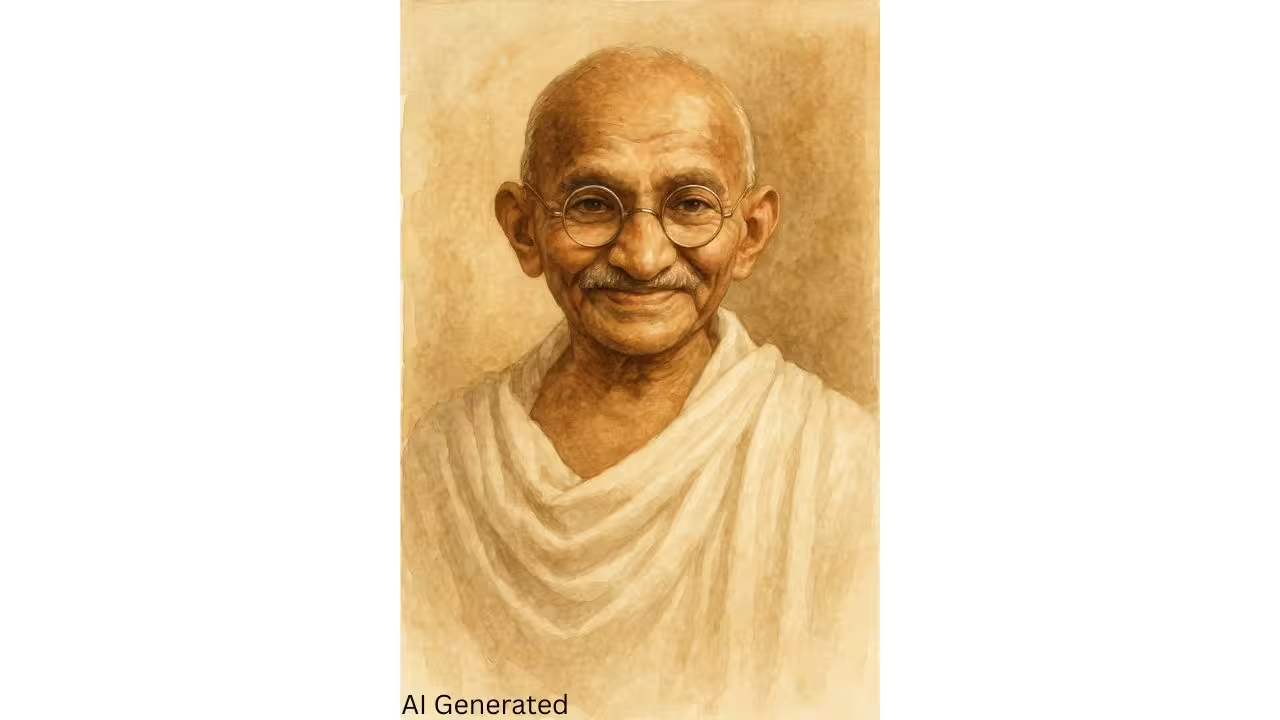
Gandhi attended schools in Rajkot and completed matriculation before traveling to London in 1888 to study law. He was admitted to the Inner Temple, London, and was called to the Bar in 1891. While in Britain, he practiced frugality and explored comparative religion and diet, reading widely across Christian, Hindu, Buddhist, and other texts—an early sign of the pluralist and ethical orientation that would mark his later life.
First Political Awakening in South Africa (1893–1914)
In 1893, Gandhi accepted a year‑long legal assignment in South Africa for an Indian merchant firm. A now‑iconic incident—his ejection from a first‑class railway compartment at Pietermaritzburg despite holding a valid ticket—shocked him into political awareness about racial discrimination. Gandhi stayed on for two decades, organizing Indians (mostly traders and laborers) against discriminatory laws.
He founded the Natal Indian Congress (1894) to represent Indian interests, launched newspapers to argue the case, and developed satyagraha during campaigns against the Asiatic Registration Act and other restrictions in the Transvaal. His strategy combined petitions, negotiation, non‑violent civil disobedience, and personal sacrifice. During the Boer War (1899–1902) and the Zulu Rebellion (1906), Gandhi organized ambulance corps, reflecting his commitment to humanitarian service even while opposing injustice.
The Satyagraha in South Africa culminated in a compromise with authorities (1914) that eased some of the harshest measures. These years were decisive: Gandhi left South Africa with a rigorously tested method of non‑violent struggle, a reputation as an ethical leader, and a blueprint for mass organization.
Return to India and Rise as a National Leader (1915–1920)
Gandhi returned to India in January 1915 and, after traveling widely to study conditions, established the Satyagraha (Kochrab) Ashram in Ahmedabad in May 1915; the ashram shifted to the Sabarmati site in June 1917. He initially took up local struggles, most famously:
- Champaran (1917): Intervention on behalf of indigo cultivators compelled to grow indigo under exploitative terms; Gandhi investigated abuses and negotiated relief, using satyagraha with strict non‑violence and constructive reform.
- Ahmedabad Mill Strike (1918): Mediated between mill owners and workers; fasted to maintain non‑violent discipline and fairness.
- Kheda Satyagraha (1918): Supported peasants in tax relief after crop failure; insisted on lawful, non‑violent pressure.
The Rowlatt Acts (1919)—which allowed detention without trial—sparked Gandhi’s empire‑wide hartals and protests. The Jallianwala Bagh massacre (13 April 1919), where British troops fired on an unarmed gathering in Amritsar, intensified nationalist resolve. By 1920, Gandhi emerged as the foremost mass leader of the Indian National Congress, uniting diverse constituencies around a program of Non‑Cooperation and Swadeshi (self‑reliance, including spinning khadi).
The Non‑Cooperation Movement and Its Suspension (1920–1922)
The Non‑Cooperation Movement (1920–22) urged Indians to boycott foreign cloth, law courts, titles, and government schools, and to build local capacity through khadi, national education, and village uplift. The movement grew rapidly, drawing students, professionals, peasants, and urban workers. However, the violent incident at Chauri Chaura (4 February 1922)—where a protesting crowd attacked a police station leading to deaths—led Gandhi to suspend the movement. He argued that the moral discipline necessary for satyagraha had yet to be mastered. Shortly thereafter, he was arrested and imprisoned (1922–1924) for sedition.
Between Mass Movements: Constructive Programme, Writings, and Reform (1924–1929)
Following his release, Gandhi focused on a constructive programme designed to remake society from the ground up:
- Khadi and Village Industries to promote self‑reliance and reduce poverty.
- Removal of “untouchability” (Gandhi used the term Harijan, “children of God,” a term now considered outdated and avoided), with campaigns for temple entry and access to public wells.
- Communal harmony between Hindus and Muslims.
- Basic education ideas that later crystallized as Nai Talim (Wardha Scheme, 1937), integrating craft, ethics, and citizenship.
- Sanitation, literacy, and women’s participation in public life.
He edited journals like Young India and later Harijan, and wrote Hind Swaraj (1909) earlier—a compact statement of his civilizational critique and vision of self‑rule—alongside his autobiography, The Story of My Experiments with Truth, serialized in the late 1920s. These texts crystallized his core ideas: truth, non‑violence, self‑discipline, decentralization, and moral politics.
The Salt March and Civil Disobedience (1930–1934)
In 1930, Gandhi transformed a tax issue into a national moral drama: the Dandi Salt March. Beginning on 12 March 1930, he and a small band walked about 240 miles from Sabarmati Ashram to the coastal village of Dandi, where on 6 April he picked up a pinch of natural salt, symbolically breaking the British salt monopoly. The act triggered mass civil disobedience across India—salt making, forest law violations, and non‑payment of taxes—met with widespread arrests.
The Gandhi‑Irwin Pact (March 1931) led to temporary concessions and Gandhi’s participation in the Second Round Table Conference (1931) in London as the sole Congress representative. The talks failed to achieve political reconciliation. Renewed civil disobedience followed, and Gandhi faced further imprisonments through the early 1930s.
Read also : Bhagat Singh Biography: Early Life, Ideology, Lahore Case, Martyrdom & Legacy
The Poona Pact and Social Justice Debates (1932)
In 1932, the British proposal for separate electorates for the “Depressed Classes” (now referred to as Scheduled Castes) prompted Gandhi to begin a fast in prison, arguing that separate electorates would deepen social divisions. After intense negotiations with Dr. B. R. Ambedkar, the leader of the Depressed Classes, the Poona Pact (24 September 1932) replaced separate electorates with reserved seats for Scheduled Castes in joint electorates, alongside additional safeguards.
This episode highlights Gandhi’s complex relationship with caste reform. He worked tirelessly against untouchability and for social equality, yet Ambedkar critiqued Gandhi’s stance on varna and structural inequality. Today, scholars discuss these disagreements to understand multiple pathways to Indian democracy and social justice.
Toward Independence: From Constructive Work to “Quit India” (1934–1945)
Through the late 1930s, Gandhi emphasized constructive work, rural uplift, and unity. When the Second World War began, he sought Indian freedom as a moral precondition for cooperation. The Cripps Mission (1942) failed to persuade Indian leaders with its proposals, leading the Congress to adopt the Quit India Resolution on 8 August 1942. Gandhi’s call—“Do or Die”—signaled uncompromising non‑violent resistance.
The British arrested Gandhi and the Congress leadership almost immediately. Gandhi spent years in detention; tragically, his wife Kasturba died in 1944 at the Aga Khan Palace prison. His own health deteriorated, but he retained the conviction that India’s liberation required both political freedom and moral reconstruction.
Partition, Communal Violence, and the Last Year (1946–1948)
As independence neared, negotiations stalled over the shape of the future state. Gandhi worked tirelessly to stem communal violence, notably walking through riot‑torn districts such as Noakhali (1946–47) and later in Bihar and Calcutta, earning credit from many observers for helping calm the city during the so‑called “Calcutta Miracle.”
On 15 August 1947, India became independent, but Partition created India and Pakistan and unleashed devastating violence and mass displacement. Gandhi—deeply pained by the bloodshed—undertook fasts to restore peace and to urge the release of financial dues to Pakistan as agreed by India. On 30 January 1948, while on his way to prayer at Birla House (Delhi), Gandhi was assassinated by Nathuram Vinayak Godse, a Hindu extremist who opposed Gandhi’s policies and commitment to inter‑communal harmony. Reports frequently state Gandhi’s last words were “Hey Ram,” though historians note this point is contested due to conflicting eyewitness accounts.
Core Ideas and Political Philosophy
Gandhi’s enduring influence stems not only from his campaigns but from a coherent, lived philosophy.
1) Satyagraha (Truth‑Force):
Satyagraha is more than passive resistance; it is active moral resistance grounded in truth and love. It insists on non‑violent means even when confronting injustice, because the means shape the ends. Satyagraha seeks to convert, not destroy, the opponent, appealing to conscience through self‑suffering, transparency, and dialogue.
2) Ahimsa (Non‑Violence):
Ahimsa is the ethical foundation of Gandhi’s politics. Non‑violence is not weakness; it demands courage, discipline, and restraint. For Gandhi, ahimsa extends beyond avoiding physical harm to refusing hatred and dehumanization in thought, word, and deed.
3) Swaraj and Swadeshi:
Swaraj (self‑rule) begins with self‑mastery—ethical self‑control—before political independence. Swadeshi complements this by encouraging local production (khadi) and decentralized economies, aiming to reduce dependency and uplift villages.
4) Sarvodaya and Trusteeship:
Sarvodaya means the welfare of all. Gandhi’s idea of trusteeship called on the wealthy to act as trustees of their surplus wealth for social good, foreshadowing modern debates on corporate responsibility.
5) Religion and Pluralism:
Deeply spiritual, Gandhi insisted that all religions share ethical cores of truth and compassion. He opposed religious bigotry, defended minority rights, and grounded public life in tolerance and dialogue.
Major Works and Publications
- Hind Swaraj (1909): A concise critique of modern civilization’s excesses and an argument for self‑rule rooted in ethics and simplicity.
- The Story of My Experiments with Truth (Autobiography, serialized 1920s): A candid moral self‑examination that links personal discipline with public action.
- Young India and Harijan (journals): Vehicles for Gandhi’s weekly commentary on politics, economics, hygiene, education, and inter‑faith relations.
- Numerous Speeches, Letters, and Addresses: Collected in the Collected Works of Mahatma Gandhi (CWMG), an essential archival resource.
Gandhi and His Contemporaries: Debates That Shaped India
Gandhi engaged robustly with colleagues and critics:
- Rabindranath Tagore is widely credited with popularizing the honorific “Mahatma.” Their respectful debates on nationalism and modernity enriched India’s intellectual life.
- Subhas Chandra Bose admired Gandhi but favored a more militant approach; he nonetheless addressed Gandhi as the “Father of the Nation” in a 1944 broadcast—a phrase widely used colloquially though not an official legal title in India.
- Muhammad Ali Jinnah and Gandhi negotiated frequently but differed on the political architecture for Hindu‑Muslim coexistence.
- B. R. Ambedkar challenged Gandhi on caste and representation; their disagreements culminated in the Poona Pact. These debates continue to illuminate democratic ethics and social justice in India.
Global Influence and Legacy
Gandhi’s techniques and ideas traveled well beyond India. Martin Luther King Jr. adopted non‑violent civil rights action in the United States after studying Gandhi. Nelson Mandela drew inspiration in South Africa, as did César Chávez in the United States and Khan Abdul Ghaffar Khan (the “Frontier Gandhi”) in the North‑West Frontier Province. The United Nations recognizes 2 October as the International Day of Non‑Violence, underscoring Gandhi’s worldwide moral resonance.
Within India, Gandhi’s legacy is visible in the Constitution’s commitment to equality and fundamental rights, in the civic idiom of non‑violent protest, and in ongoing experiments with local self‑government, sanitation, rural industries, and social inclusion. His portrait on Indian currency and statues across the world symbolize public esteem, while scholarly debates ensure his ideas remain intellectually alive.
Criticisms and Reassessments: A Balanced View
A rigorous biography must also note critiques:
- Caste and Social Reform: Critics argue that Gandhi’s approach to caste—opposing untouchability while not always rejecting varna in his early writings—did not go far enough. Gandhi’s stance evolved, and he increasingly emphasized the moral wrong of untouchability and the equality of all citizens.
- Race in Early South Africa: Some of Gandhi’s early remarks have been criticized; his views changed as he confronted broader injustices and developed a universalist ethic.
- Economics and Industrialization: Gandhi’s preference for small‑scale production and village industries is questioned by those who favor industrial growth. Defenders see in Gandhi an early voice for sustainable development and human‑scale economies.
- Means and Ends: Admirers praise his insistence that means must match ends; skeptics consider it impractical in certain contexts. These tensions keep Gandhi central to debates on democratic strategy and ethics.
Key Dates at a Glance
- 1869: Born at Porbandar, 2 October.
- 1888–1891: Law studies in London; called to the Bar at Inner Temple (1891).
- 1893–1914: South Africa years; Natal Indian Congress (1894); satyagraha campaigns.
- 1915: Returns to India; founds Sabarmati Ashram.
- 1917–1918: Champaran, Ahmedabad mill strike, Kheda satyagraha.
- 1919: Rowlatt Satyagraha; Jallianwala Bagh massacre.
- 1920–1922: Non‑Cooperation Movement; suspended after Chauri Chaura; imprisoned.
- 1930: Dandi Salt March; civil disobedience.
- 1931: Gandhi‑Irwin Pact; attends Second Round Table Conference.
- 1932: Fast against separate electorates; Poona Pact with Dr. B. R. Ambedkar.
- 1942–1944: Quit India; imprisonment; death of Kasturba Gandhi (1944).
- 1946–1947: Peace missions in Noakhali and elsewhere; independence and Partition (15 August 1947).
- 1948: Assassinated in Delhi, 30 January.
FAQs: Concise, Accurate Answers
Q1. Who gave the title “Mahatma” to Gandhi?
A: The honorific “Mahatma” (great soul) is widely associated with Rabindranath Tagore’s usage and public adoption in the 1910s–1920s. It is an honorific, not a legal title.
Q2. Is Gandhi officially the “Father of the Nation” of India?
A: The phrase is widely used informally (famously by Subhas Chandra Bose in 1944), but there is no constitutional or legal proclamation conferring an official title.
Q3. What is the essence of Gandhi’s political method?
A: Satyagraha—non‑violent civil resistance rooted in truth, self‑discipline, and willingness to suffer without hatred—combined with a constructive programme for social reform.
Q4. Which books should a beginner read to understand Gandhi?
A: Start with Hind Swaraj (1909) and The Story of My Experiments with Truth (autobiography), then explore selections from the Collected Works of Mahatma Gandhi and the journals Young India and Harijan.
Q5. What are Gandhi’s most significant campaigns?
A: In South Africa: resistance to discriminatory laws and the formulation of satyagraha. In India: Champaran (1917), Non‑Cooperation (1920–22), Salt March and Civil Disobedience (1930–34), and Quit India (1942).
At The End
Gandhi did not present a quick route to victory. He offered a discipline—a way to hold power accountable without reproducing its violence; a method to bind freedom with responsibility; and a call to rebuild society through equality, labor, and truth. In moments of polarization and authoritarian drift, Gandhi’s insistence that means are ends in the making remains a demanding, practical, and humane guide.
Reference Links (Authoritative & Relevant)
- Encyclopaedia Britannica — Mahatma Gandhi (comprehensive biography and chronology): https://www.britannica.com/biography/Mahatma-Gandhi
- Gandhi Heritage Portal — texts, timelines, photographs, and archival resources: https://www.gandhiheritageportal.org/
- Collected Works of Mahatma Gandhi (CWMG) — searchable official corpus: https://www.gandhiheritageportal.org/the-collected-works-of-mahatma-gandhi
- National Gandhi Museum & Library — exhibits, timelines, and resources: https://www.gandhimuseum.org/
- Government of India — Gandhi 150 (Ministry of Culture) — curated resources on Gandhi’s life and ideas: https://www.gandhi.gov.in/
- United Nations — International Day of Non‑Violence (2 October): https://www.un.org/en/observances/non-violence-day