
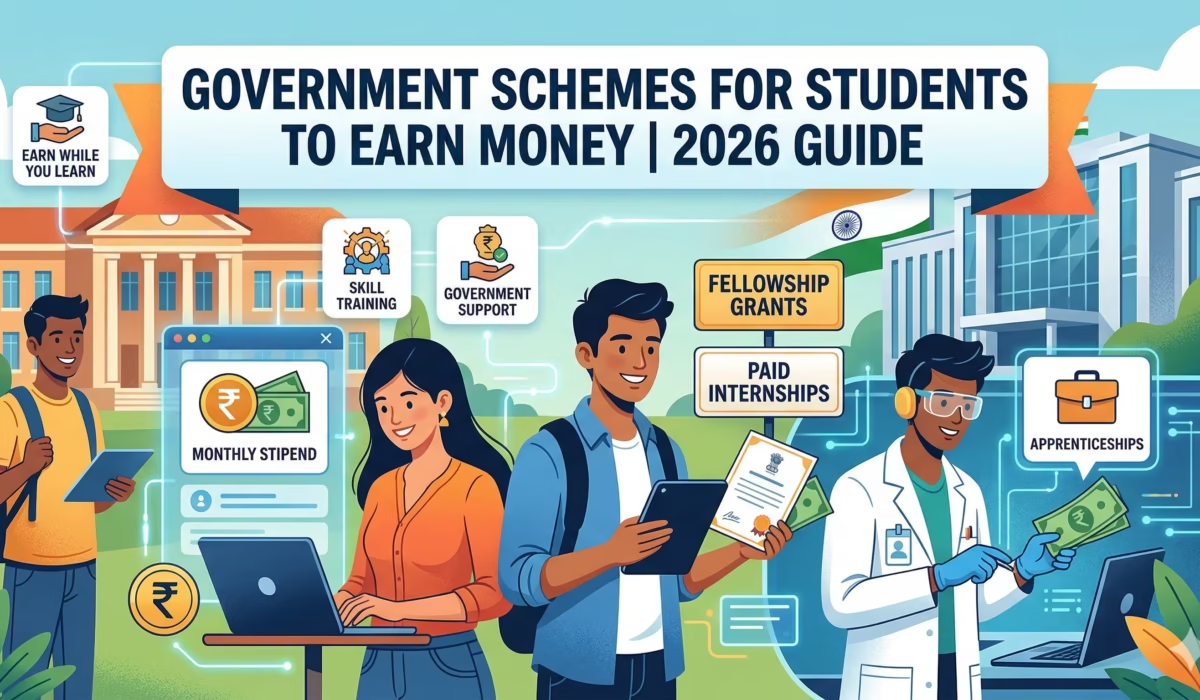
As the educational landscape evolves, the focus is rapidly shifting from traditional tuition fee waivers to empowering youth through financial independence and practical experience. For students looking to support their personal expenses, gain industry exposure, and build their resumes, relying on a Government Schemes for Students to Earn Money list is the smartest approach. These initiatives—ranging from “Earn While You Learn” programs to government-funded corporate internships—are designed to provide direct stipends, fellowships, and pocket money in exchange for skill-building, research, or part-time campus work.
Whether you are an undergraduate, postgraduate, or diploma student, these programs allow you to achieve financial stability without compromising your academic journey.
Top Government Schemes for Students to Earn Money
Below is a curated list of the best government schemes for students that strictly offer direct financial stipends, paid internships, or “earn while you learn” opportunities.
1. Prime Minister’s Internship Scheme (PMIS)
- Overview: A flagship initiative aimed at bridging the gap between academic learning and industry demands by providing one crore youth with internship opportunities in India’s top 500 companies over five years.
- Key benefits: Interns receive a direct monthly financial assistance stipend of ₹5,000 for the entire 12-month duration, plus comprehensive insurance coverage under PMJJBY and PMSBY.
- Eligibility: Youth who have passed Class 12th, ITI, Diploma, or Graduation, and are not engaged in formal full-time employment.
- Launch year / authority: 2024–2025 / Ministry of Corporate Affairs (MCA), Government of India.
2. AICTE Internship Enterprise Portal Programs
- Overview: The All India Council for Technical Education (AICTE) portal acts as a bridge connecting students with paid internships across MSMEs, tech companies, and government bodies (like the recent AICTE MSME Virtual Internship).
- Key benefits: Highly lucrative stipends depending on the specific internship. Current 2026 postings offer stipends ranging from ₹10,000 to ₹15,000 per month for virtual and in-person domain-specific projects.
- Eligibility: UG and PG students enrolled in AICTE-approved institutions (Engineering, Management, Applied Arts, etc.).
- Launch year / authority: Ongoing / All India Council for Technical Education (MoE).
3. State-Level “Earn While You Learn” (EWYL) Schemes
- Overview: Multiple state governments and state-run universities have adopted EWYL policies. Students are employed part-time on campus in libraries, laboratories, data entry, and software development, allowing them to earn money during free hours.
- Key benefits: Students are typically paid on an hourly basis (e.g., ₹75 to ₹100 per hour), allowing them to earn up to ₹2,500 to ₹3,000 per month without disrupting their study schedules.
- Eligibility: Meritorious and financially needy students enrolled full-time in participating state universities and degree colleges.
- Launch year / authority: Various (State Higher Education Departments & University IQACs).
4. NHAI Summer Internship Programme
- Overview: A highly sought-after program where students learn about the planning, execution, and management of national highway projects by working under senior officials at NHAI field offices and headquarters.
- Key benefits: Selected candidates receive a generous stipend of ₹20,000 per month for the two-month duration, alongside a valuable completion certificate.
- Eligibility: Undergraduate and postgraduate students pursuing civil engineering, as well as streams like IT, data science, finance, law, and management.
- Launch year / authority: Updated annually (2026 intake open) / National Highways Authority of India (NHAI).
5. ICAR Student READY Programme
- Overview: The Rural Entrepreneurship Awareness Development Yojana (READY) helps agriculture students build confidence and acquire hands-on entrepreneurial skills through rural training and industrial attachment.
- Key benefits: A direct stipend of ₹3,000 per student per month for a maximum of six months via Direct Benefit Transfer (DBT).
- Eligibility: Students pursuing undergraduate programs in State/Central Agricultural Universities duly accredited by ICAR.
- Launch year / authority: 2015–16 / Indian Council of Agricultural Research (ICAR).
6. National Human Rights Commission (NHRC) Paid Internship
- Overview: Designed to spread human rights literacy, this program offers intensive offline and virtual training, bringing university students into the core of social justice and human rights administration.
- Key benefits: In-person interns receive a stipend of ₹12,000 plus a travel allowance (3rd AC train fare). Virtual interns receive a stipend of ₹2,000.
- Eligibility: Students in the 3rd year onwards of an integrated PG/Law course, final year of graduation, or enrolled in PG degree courses, maintaining a minimum of 60%–65% marks.
- Launch year / authority: 1998 (Updated regularly) / National Human Rights Commission.
7. NIDM Stipend-Based Internship Programme
- Overview: Conducted bi-annually (summer and winter), this program engages young minds in disaster risk reduction and capacity building through practical, hands-on learning at the national level.
- Key benefits: Undergraduates receive a stipend of ₹12,000 per month, while postgraduates receive ₹15,000 per month for an internship period spanning 8 to 16 weeks.
- Eligibility: Students with at least 65% marks in their last academic program/semester.
- Launch year / authority: Ongoing / National Institute of Disaster Management (Ministry of Home Affairs).
8. National Apprenticeship Promotion Scheme (NAPS)
- Overview: A scheme designed to promote apprenticeship training across India by incentivizing employers to hire and train students, blending basic training with on-the-job practical experience.
- Key benefits: The government shares 25% of the prescribed stipend (up to ₹1,500 per month) with employers. Consequently, student apprentices routinely earn between ₹5,000 to ₹10,000+ per month depending on their chosen trade.
- Eligibility: Any student/candidate above 14 years of age with basic educational qualifications (ITI, Diploma, or Degree).
- Launch year / authority: 2016 / Ministry of Skill Development and Entrepreneurship.
How to Choose the Right Scheme
With so many options available, maximizing your student stipend eligibility and benefits requires a strategic approach. Consider these key factors before applying:
- Academic Alignment: Choose programs that complement your degree. Engineering students should target AICTE and NHAI portals, while social science students will benefit most from NHRC or NIDM programs.
- Time Commitment: Evaluate if you can handle a full-time summer internship (like NHAI) or if you need a part-time/hourly setup (like University EWYL schemes) that runs concurrent with your classes.
- Location Flexibility: If relocating is a financial burden, actively search the AICTE portal for high-paying virtual internships, or stick to on-campus employment.
2026-Specific Updates Section
The landscape for student earning opportunities has seen massive boosts in early 2026. Keep an eye on these latest schemes 2026:
- Maharashtra’s New ₹2,000 Monthly Stipend for Girls: Launched in alignment with the Social Stock Exchange (SSE) and FUEL in April 2026, the Maharashtra Higher and Technical Education Department is rolling out a dedicated “Earn While You Learn” policy. It provides female college students with a ₹2,000 monthly stipend for daily expenses, completely independent of existing tuition waivers.
- NHAI’s Expanded 2026 Drive: Registrations opened in March 2026 for NHAI’s summer program, solidifying a competitive ₹20,000/month stipend and notably expanding eligibility beyond Civil Engineering to include IT, Data Science, Mass Comm, and Law students.
- AICTE AURA & Productization Fellowships: AICTE has introduced new 2026 fellowship pathways (like the AICTE Productization Fellowship) to fund students building innovative ideas contributing to the “Viksit Bharat 2047” vision, adding to their robust list of paid virtual MSME internships.
FAQs
Q: Are these government schemes completely free to apply for? A: Yes. Official government platforms (like myScheme, the AICTE Internship Portal, or university websites) never charge application or registration fees. Always ensure you are applying through official .gov.in or .ac.in domains.
Q: Can I apply for an “Earn While You Learn” scheme and a standard scholarship at the same time? A: In most cases, yes. Standard scholarships (like NSP or PM-USP) cover your tuition and academic fees, while schemes like university EWYL programs or summer internships pay you for your labor and time. However, always check the specific terms of your primary scholarship to ensure dual-beneficiary rules are not violated.
Q: What documents are primarily required to prove student stipend eligibility and benefits? A: You will generally need your Aadhaar card (for Direct Benefit Transfer), a valid bank account linked to Aadhaar, current college ID/bonafide certificate, past academic mark sheets, and occasionally an income certificate or category certificate.
Q: Where can I find the latest government schemes for students to earn money? A: The most reliable aggregators are the National Scholarship Portal (NSP), the myScheme portal (myscheme.gov.in), and the AICTE Internship Enterprise Portal. Regularly checking your university’s IQAC or Student Welfare board will also keep you updated on local part-time campus jobs.