
The history of India’s freedom struggle is dominated by figures of quiet non-violence and steadfast political negotiation. But lurking just outside that mainstream narrative lies a story of explosive armed rebellion, deep philosophical polarization, and spine-chilling personal suffering. At the dead center of this historical maelstrom stands vinayak damodar savarkar—a revolutionary, poet, and philosopher whose very name continues to act as a lightning rod in Indian politics.
Decades after his death, Savarkar is simultaneously revered as an ultimate nationalist hero and deeply criticized as a polarizing ideologue. But setting modern political leanings aside, his life reads less like standard history and more like an edge-of-the-seat political thriller. From building secret underground networks and executing jaw-dropping escapes from colonial captivity, to enduring unimaginably cruel torture in the darkest prison of the British Empire, veer savarkar lived a life defined by extremes.
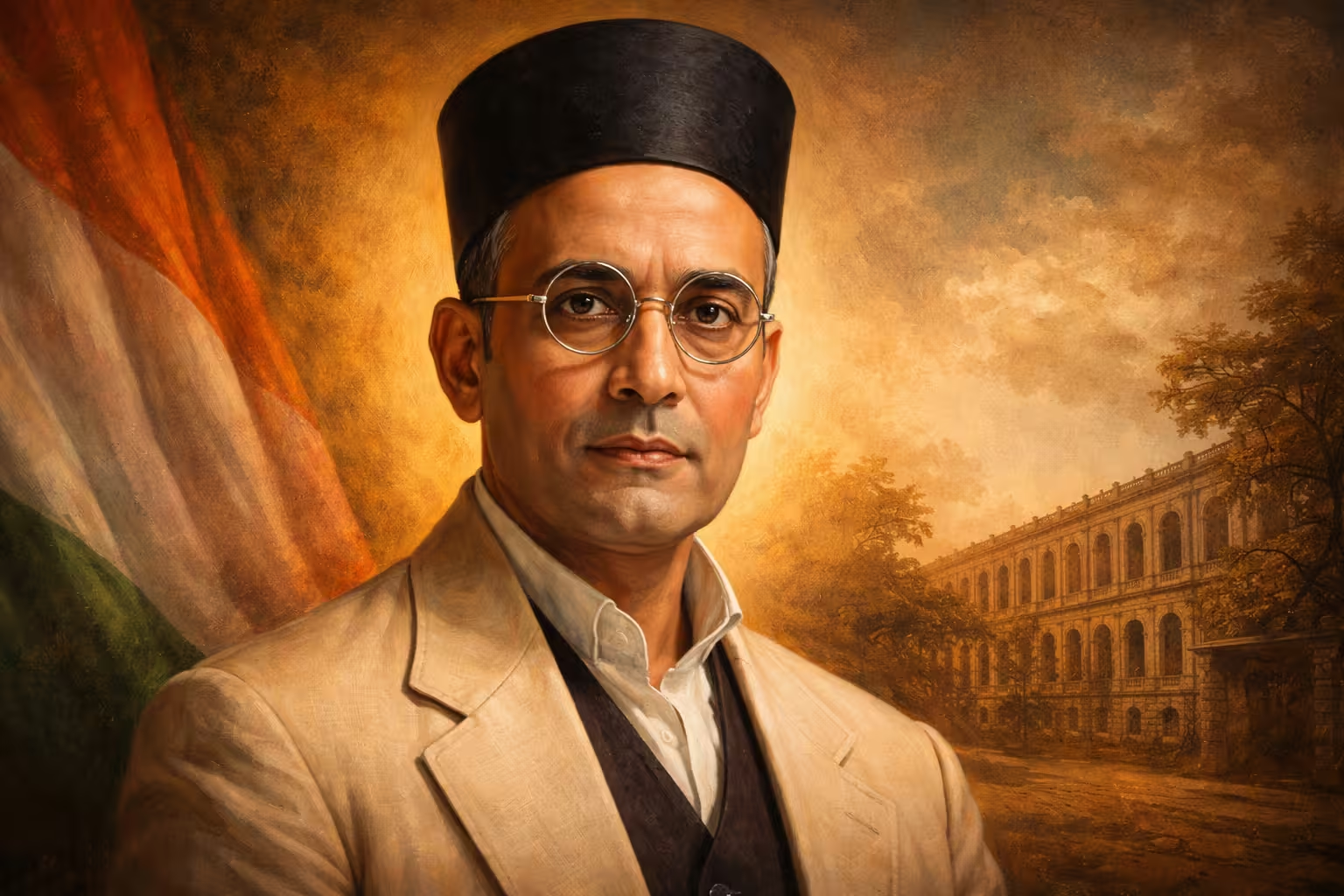
As India aggressively reclaims its cultural roots and marks the deeply significant 60th anniversary of savarkar punyatithi in early 2026, understanding his ideology has become crucial. Let’s unravel the suspense, the myths, and the verified historical realities of a revolutionary mastermind whose shadow looms over India more powerfully today than ever before.
The Oath in the Shadows: The Birth of a Revolutionary
Born on May 28, 1883, in the unassuming village of Bhagur near Nashik, Maharashtra, vinayak damodar savarkar was heavily influenced by Hindu epics, history, and the sting of colonial subjugation. The public execution of the Chapekar brothers by the British in 1899—for assassinating Plague Commissioner W.C. Rand—ignited a fierce, permanent rebellion in the mind of the teenage Savarkar.
In a moment ripped straight from a cinematic saga, a 15-year-old Savarkar stood before his family deity, Goddess Ashtabhuja, and took a blood-oath to drive the British out of Bharatavarsha.
He didn’t just dream of freedom; he actively organized for it:
- Mitra Mela (1899): While barely out of school, he created a youth organization designed to foster physical fitness and political awakening among Indian youth.
- Abhinav Bharat Society (1904): During his days at Fergusson College in Pune, Mitra Mela morphed into the secret society Abhinav Bharat. This underground network of armed revolutionaries systematically learned about weapon-making and assassination plots, vowing absolute destruction of the colonial regime.
For the British Criminal Intelligence Department (CID), a brilliant, charismatic youth organizing armed squads was a terrifying prospect. But before they could completely close their net, Savarkar expanded his vision across the globe.
London’s Underground: Arming an Empire’s Downfall
In 1906, leveraging a scholarship arranged by the renowned Indian nationalist Shyamji Krishna Varma, Savarkar set sail for London under the pretense of studying law. In reality, he was establishing an international nerve center for the Indian armed struggle.
He resided at India House in London, converting it into a lethal workshop for revolution. It was here that he performed dual miracles of both the pen and the sword:
The Literary Thunderbolt: He spent days holed up in the British Library, secretly perusing colonial archives to draft his magnum opus: The Indian War of Independence 1857. Before Savarkar, British historians dismissively called the 1857 uprising a mere “Sepoy Mutiny.” Savarkar aggressively challenged this, framing it as an incredibly well-coordinated nationalist war for liberation. The British panicked and banned the manuscript globally. When it was successfully smuggled and published, it became the underground bible for iconic revolutionaries, including Bhagat Singh and Netaji Subhas Chandra Bose[1][2].
The Network of Fire: Under Savarkar’s quiet leadership, India House translated Russian bomb-making manuals and smuggled pistols hidden in false-bottomed luggage directly into Maharashtra. When his close associate Madan Lal Dhingra shot dead the British official Sir William Hutt Curzon Wyllie in 1909, Scotland Yard closed in. Arrested in London in 1910 on charges of treason and arms smuggling, Savarkar knew an inescapable execution or life imprisonment awaited him.
The Leap at Marseilles: An Escape That Shook The World
What happened in July 1910 propelled veer savarkar from a local political rebel to a global household name. Handcuffed and heavily guarded, he was being transported back to India aboard the SS Morea to face trial.
As the vessel dropped anchor near the French port of Marseilles, Savarkar saw an impossibly tiny window of opportunity. Pleading to use the ship’s small washroom, he forced his body through an exceptionally narrow, bolted porthole, scraping the skin off his ribs, and dropped into the ocean. Swimming desperately to the French shores amidst incoming gunfire, he claimed political asylum upon hitting land.
Tragically, confused French maritime guards violated international maritime law by handing him right back to British officers. But his incredible, death-defying escape created a massive international furor. The controversy traveled all the way to the Permanent Court of Arbitration at The Hague. Though the European powers ruled in favor of the British, Savarkar had successfully drawn unprecedented global attention to the Indian independence struggle.
Returning to India, the British judicial system exacted a heavy revenge: two consecutive life sentences—amounting to 50 years—exiling him to the Cellular Jail in the Andaman and Nicobar Islands.
Kala Pani: Torture, Survival, and The Petition Controversy
From 1911, the story of vinayak damodar savarkar moved into the darkest realm imaginable: Kala Pani. Built with solitary confinement as its core architecture, the Cellular Jail in Port Blair was specifically designed to psychologically annihilate Indian rebels[3][4].
- The Physical Horrors: Stripped of fundamental human dignity, political prisoners were yoked like cattle to the oil press (kolhu), forced to extract immense daily quotas of coconut oil. Any signs of fatigue were met with savage floggings.
- The Poetry of the Walls: Deprived of pen or paper for a decade, Savarkar famously wrote more than 6,000 lines of soaring, agonizing Marathi poetry directly onto the prison walls using thorns and nails[5]. He committed every word to memory, later whispering the verses to incoming prisoners to ensure the poetry survived the gallows.
The Clemency Petitions:
This chapter of Kala Pani gives birth to the fiercest debate surrounding his legacy today. During his excruciatingly long imprisonment, veer savarkar filed multiple clemency petitions requesting his release. His detractors wield these petitions today as evidence of cowardice and capitulation to the British.
Conversely, his supporters and several military historians insist these letters were brilliant acts of tactical deception. Revolutionary codes often allowed for any legal maneuver necessary to escape a useless death in a forgotten cell to re-join the fight from the outside. Whatever the true internal motive, the unbearable trauma of Kala Pani dramatically changed him, molding the intensely hardened ideological thinker the world knows today.
The Ratnagiri Diaries: The Forgotten War on Social Dogma
Due to public pressure and sustained petitions, the British conditionally released Savarkar in 1924. But he wasn’t free. He was confined under a strict gag order to the remote Ratnagiri district in Maharashtra, strictly barred from political activity. Denied the sword of politics, Savarkar unleashed his fury onto a new battlefield: toxic social evils.
Many historians note that Savarkar’s social reforms were staggeringly ahead of his time, although often entirely ignored by modern political commentary[2][6].
- War Against Untouchability: Savarkar identified the deeply rooted caste system as the singular fatal flaw that kept Hindu society subservient. He publicly decried caste discrimination as an inhumane abomination.
- Sahabhojan (Inter-Caste Dining): Defying absolute social boycotts and orthodox fury, he aggressively organized mass dining events where the “upper” castes and “untouchables” shared meals shoulder-to-shoulder—an outrageously revolutionary act for the 1920s.
- Patit Pavan Mandir: In 1931, he successfully constructed the Patit Pavan Mandir in Ratnagiri—one of India’s first temples universally accessible to all castes[5].
- Scientific Temper: While the mainstream nationalist movement often romanticized rural spiritualism, Savarkar championed hyper-modernization, mechanization, and absolute scientific temper, pleading with his countrymen to throw off irrational superstitions.
The Ideology of Hindutva & The Gandhi Confrontation
It was during his restriction that Savarkar synthesized the explosive manifesto, Hindutva: Who is a Hindu? in 1923. In it, he systematically defined Indian nationhood not by a strict religion, but through geography and common cultural lineage. He classified a Hindu as someone who considers the land from the Indus to the Seas as both their Pitrubhu (Fatherland) and Punyabhu (Holy Land).
When finally released from all restrictions in 1937, he was immediately thrust to the apex of the Hindu Mahasabha. It was here that his ideology aggressively violently collided with Mahatma Gandhi and the Indian National Congress.
- Clash over Ahimsa (Non-violence): While Gandhi elevated non-violence to an absolute spiritual doctrine, Savarkar vehemently believed that complete non-violence against brutal aggressors was historical suicide.
- The Appeasement Accusation: He brutally criticized the Congress for political appeasement, insisting that continuous concessions ultimately triggered the catastrophic Partition of India in 1947.
- The Assassination Trial: The most devastating blow to his legacy came in 1948. Following the assassination of Mahatma Gandhi, an aging Savarkar was dramatically arrested and tried as a conspirator. After an intense, exhausting trial, the court fully acquitted him of all charges due to a complete lack of corroborating evidence. The acquittal was absolute, but the political stain engineered by his critics was permanent.
Atmaarpan: The Ultimate Sacrifice
Living out his twilight years at his residence in Bombay, vinayak damodar savarkar refused to let sickness or circumstance dictate his end. In early 1966, the 82-year-old warrior wrote an impassioned piece titled Atmahatya Nahi Atmaarpan (Not Suicide, but Self-Surrender).
Drawing upon deeply ancient yogic and Jain spiritual texts, he argued that when an individual completes their life mission and loses their physical ability to actively serve society, it is the ultimate act of honor to consciously and intentionally welcome death through a complete renunciation of worldly elements.
Beginning February 1, 1966, he completely ceased all intake of food, water, and medicines. He starved his mortal coil deliberately for nearly a month, showcasing unbelievable willpower. Finally, on February 26, 1966, his tormented, fierce soul was released[5][7]. Millions today solemnly observe this incredible act of sheer willpower on the historic anniversary of savarkar punyatithi.
2026 and Beyond: Why Savarkar Still Dominates Indian Politics
If the British thought history would slowly bury him, modern India proved them spectacularly wrong. As of 2026, the polarizing intellectual specter of veer savarkar dictates real-world legislative narratives, supreme court drama, and deeply massive geopolitical branding[8][9].
Just ahead of the momentous 60th anniversary of savarkar punyatithi, December 2025 witnessed a massive demonstration of political alignment by India’s ruling administration[4][10]. Union Home Minister Amit Shah, alongside RSS Chief Mohan Bhagwat, flew precisely to the very grounds of his unimaginable suffering: the Andaman and Nicobar Islands.
In a towering ceremony at Beodnabad in the South Andaman district, they unveiled a massive life-sized statue of the freedom fighter in the newly inaugurated “Veer Savarkar Inspiration Park”[1][2][6]. Standing on the soil of what was previously known as Port Blair (now definitively renamed Sri Vijaya Puram)[3][4], Shah thundered to a highly emotive crowd that history deliberately failed to afford Savarkar his proper standing as a fearless pioneer against the cruel evils of caste untouchability[6]. They commemorated exactly 116 years since he composed the heartbreaking lines of Sagara Pran Talmalala (My Soul Is In Torment)[1][6].
Simultaneously, the man’s legacy runs entirely unchecked inside modern Indian courtrooms. Throughout late 2025 and into early 2026, Savarkar returned aggressively to newspaper front-pages via a volatile, extremely high-profile defamation case filed against Leader of the Opposition Rahul Gandhi by Satyaki Savarkar (the revolutionary’s grandnephew)[8][9]. Stemming from allegations that Gandhi continuously disrespected the freedom fighter on global stages, Pune courts buzzed with controversy as blank evidence CDs and explosive lawyer withdrawals dominated daily proceedings up through late February 2026[8][11][12]. This non-stop judicial drama consistently spotlights just how deeply veer savarkar still electrifies modern discourse.
Every word he penned, every sentence he fought against, and every modern statute raised in his honor represents a society currently grappling with massive historical corrections. Whether revered as a pioneer of uncompromising Hindutva and unmatched bravery, or vilified for ideological exclusivity, his blueprint acts as a high-stakes mirror reflecting India’s modern ideological destiny. As countless followers light digital and physical lamps commemorating the 60th cycle of savarkar punyatithi this year[10], the intense geopolitical waves generated from the dark walls of Kala Pani only prove one profound absolute: you can jail his body, and you can challenge his legacy, but vinayak damodar savarkar has proven entirely immune to being erased.