
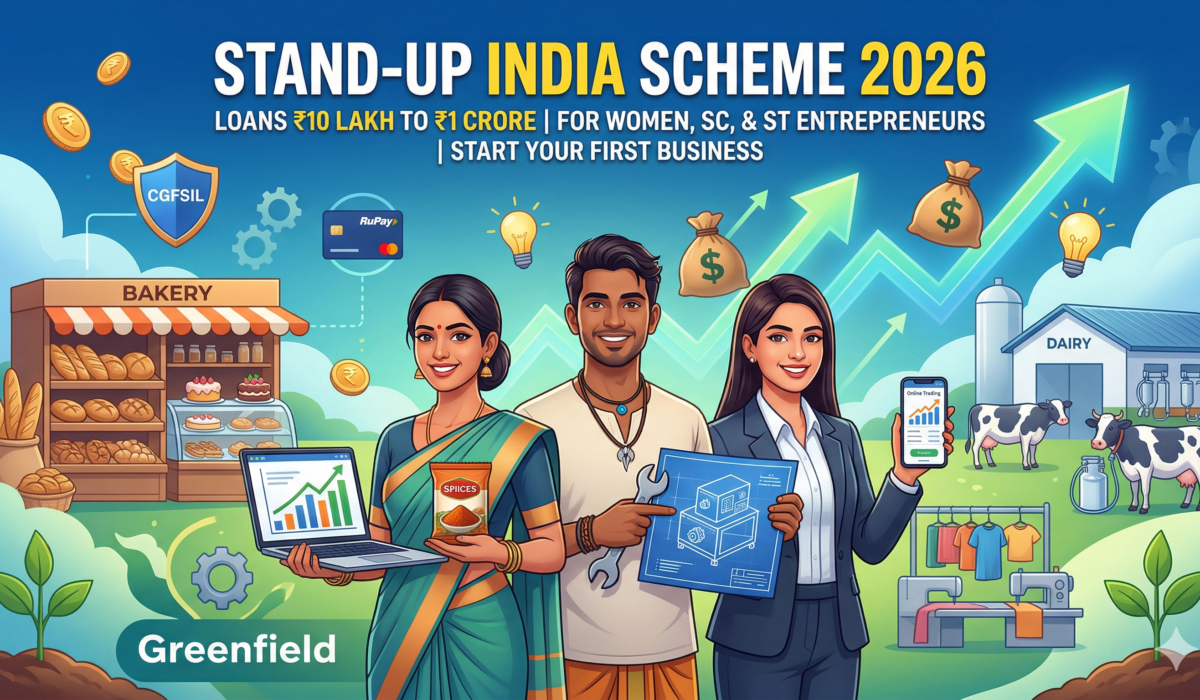
The Stand-Up India Scheme is a transformative, flagship initiative introduced by the Central Government to promote entrepreneurship at the grassroots level. It specifically focuses on economic empowerment, inclusive growth, and large-scale job creation among traditionally underrepresented communities. Designed to permanently bridge the financial gap for minority and female entrepreneurs, the scheme provides substantial bank loans to help individuals from Scheduled Castes (SC), Scheduled Tribes (ST), and women establish their very first business ventures.
Historically, talented individuals from marginalized backgrounds and aspiring female business owners have faced immense hurdles in securing institutional credit due to a lack of collateral, absent credit histories, or limited advisory networks. The Stand-Up India Scheme dismantles these barriers. Since its inception, the initiative has sanctioned over ₹40,700 crore to more than 1.8 lakh accounts—with women entrepreneurs alone accounting for over 1.44 lakh of these loans.
If you are planning to start a completely new business and need strong financial backing, this comprehensive, step-by-step guide covers everything. From deeply understanding the Stand-Up India Scheme eligibility criteria to gathering the required documents and navigating the online application process via the Stand-Up Mitra portal, this article is your complete roadmap for 2026.
Overview of the Stand-Up India Scheme
At its core, the Stand-Up India Scheme is an institutional credit mandate. It legally directs all branches of Scheduled Commercial Banks in India to facilitate bank loans to at least one SC or ST borrower and at least one woman borrower per branch.
- Purpose of the Scheme: To provide formal institutional credit to underserved demographics (women, SC, and ST communities) strictly for setting up completely new business establishments—known as “Greenfield” enterprises.
- Launch Date: April 5, 2016.
- Launched By: Department of Financial Services (DFS), Ministry of Finance, Government of India.
- Implementing Agencies: Small Industries Development Bank of India (SIDBI) and the National Bank for Agriculture and Rural Development (NABARD).
- Target Beneficiaries: Women entrepreneurs (across all societal categories) and male entrepreneurs belonging to the Scheduled Caste (SC) or Scheduled Tribe (ST) communities.
Key Highlights of the Stand-Up India Scheme
Understanding the basic parameters of the scheme is crucial before applying. Below is a quick-reference summary of the scheme’s core features:
| Feature | Detailed Specification |
|---|---|
| Scheme Name | Stand-Up India Scheme |
| Administered By | Ministry of Finance, alongside SIDBI and NABARD |
| Loan Amount Limit | ₹10 Lakh (Minimum) to ₹1 Crore (Maximum) |
| Target Beneficiaries | Women (all categories), SC, and ST entrepreneurs |
| Eligible Projects | Greenfield Enterprises only (your absolute first-time venture) |
| Supported Sectors | Manufacturing, Services, Trading, and Agriculture-allied activities |
| Margin Money | Up to 15% (Borrower must independently contribute a minimum of 10%) |
| Repayment Tenure | Up to 7 years (with an 18-month moratorium/grace period) |
| Credit Guarantee | Backed by CGFSIL (Credit Guarantee Fund Scheme for Stand-Up India Loans) |
| Official Portal | www.standupmitra.in |
What are the Core Objectives of the Scheme?
The government introduced the Stand-Up India Scheme not merely as a loan program, but as a holistic ecosystem designed to address the unique challenges faced by minority and female entrepreneurs. The primary objectives go far beyond basic financial aid:
- Promoting True Financial Inclusion: Ensuring that heavy capital reaches grassroots innovators who historically face institutional barriers to borrowing. It forces the banking sector to actively look for and fund underrepresented talent.
- Transitioning from Job Seekers to Job Creators: By empowering women and individuals from SC/ST communities, the government aims to shift the economic paradigm. A successful Stand-Up India beneficiary will naturally hire local staff, creating a cascading effect of employment in their community.
- Fostering First-Time Entrepreneurs: The scheme focuses exclusively on “Greenfield” projects. This guarantees that capital is being used to generate new infrastructure, new industries, and fresh employment opportunities from scratch, rather than merely inflating existing, already-successful businesses.
- Providing Comprehensive Handholding Support: Recognizing that money alone does not guarantee business success, the scheme connects applicants with local support centers. Through the Stand-Up Mitra portal, applicants receive mentoring, financial literacy training, skill development, and help with drafting Detailed Project Reports (DPRs).
What are the Benefits of the Stand-Up India Scheme?
Entrepreneurs who successfully apply for the Stand-Up India loan enjoy several financial, operational, and structural advantages that are unmatched by standard commercial business loans:
- Substantial Loan Amount for Major Projects: Borrowers receive a composite loan—which is a combination of a term loan (for buying machinery, land, and assets) and working capital (for daily operations)—ranging from ₹10 Lakh to ₹1 Crore. This loan covers up to 85% of the total projected business cost.
- Highly Favorable Interest Rates: The interest rate applied is strictly regulated. It is guaranteed to be the lowest applicable rate of the lending bank for that specific rating category. Legally, the interest rate cannot exceed the base rate (MCLR) + 3% + tenor premium.
- Generous 18-Month Moratorium: Setting up a new business takes time, and profits aren’t immediate. The loan features a repayment tenure of up to 7 years, but crucially includes a “moratorium” (grace period) of up to 18 months. During these first 18 months, you do not have to pay the principal EMI, giving your business time to stabilize and break even.
- Collateral-Free Options via CGFSIL: One of the biggest hurdles for first-time entrepreneurs is the lack of property to pledge as collateral. Under this scheme, loans can be secured by the Credit Guarantee Fund Scheme for Stand-Up India Loans (CGFSIL), managed by NCGTC. For loans up to ₹50 lakh, the government guarantees 80% of the default amount, meaning banks are highly willing to lend without asking you for personal real estate collateral.
- Reduced Margin Money with State Convergence: While the scheme covers 85% of the project cost, the margin money requirement (your down payment) is capped at 15%. However, the borrower is strictly required to bring in only a minimum of 10% from their own pocket. The remaining 5% can be sourced through convergence with other State/Central subsidy schemes (for example, the Maharashtra Social Justice Department offers margin money grants for SC/Neo-Buddhist entrepreneurs).
- RuPay Debit Card for Working Capital: For working capital limits up to ₹10 Lakh, borrowers are issued a special RuPay debit card. This allows entrepreneurs to conveniently withdraw cash or make digital payments for day-to-day operational expenses without visiting the bank branch.
Stand-Up India Scheme Eligibility: Who Can Apply?
To maintain the integrity of the scheme and ensure funds reach the intended demographic, the government has set strict eligibility parameters. You must meet all the following criteria:
- Age Limit: The primary applicant must be at least 18 years of age.
- Category Requirement: * You must be a Woman entrepreneur (belonging to any caste, including General and OBC categories) OR
- You must be a Male entrepreneur belonging specifically to the Scheduled Caste (SC) or Scheduled Tribe (ST) category.
- Enterprise Type (Greenfield Only): This is the most critical rule. The loan is strictly for Greenfield ventures. A greenfield project signifies the very first business venture of the beneficiary in the manufacturing, services, or trading sector.
- Example of Greenfield: Buying an empty plot and building a brand-new bakery.
- Example of Non-Greenfield (Ineligible): Taking a loan to add a new oven to a bakery you have already been running for three years.
- Allied Agricultural Activities: The scheme covers activities allied to agriculture, such as poultry farming, dairy, beekeeping, pisciculture (fish farming), livestock rearing, grading, sorting, and agro-processing units. Note: Direct crop loans (buying seeds/fertilizers for standard farming) are excluded.
- Company Ownership (Non-Individual Entities): If you are not running a sole proprietorship, but rather a Private Limited Company or an LLP, at least 51% of the shareholding and controlling stake must legally be held by an SC, ST, or Woman entrepreneur.
- Clean Credit History: The applicant must not be an NPA (Non-Performing Asset) or a defaulter to any bank, NBFC, or financial institution. A good CIBIL score is highly recommended.
Documents Required for Stand-Up India Loan
Because this involves high-ticket commercial lending, the documentation process is thorough. Preparing these documents in advance significantly speeds up your loan approval. The complete list of documents required includes:
1. Applicant KYC Documents
- Identity Proof: Aadhaar Card, PAN Card, Voter ID, Driving License, or Passport. (PAN is mandatory for commercial loans).
- Address Proof: Recent utility bills (electricity/water), property tax receipt, or Aadhaar Card.
- Category Certificate: A valid, government-issued SC/ST certificate provided by a competent revenue authority (if applying under the SC/ST male quota or taking advantage of SC/ST specific subsidies).
- Photographs: 3-4 recent passport-sized photographs of the applicant(s)/promoters.
2. Business and Financial Documents
- Business Address Proof: A registered lease agreement, rent agreement, or property ownership documents for the commercial premises where the business will operate.
- Detailed Project Report (DPR): This is the most important document. Your DPR must be a comprehensive business plan detailing the total project cost, machinery quotations, revenue projections for the next 3-5 years, daily operational plans, margin money details, and a market feasibility study.
- Bank Statements: The last 6 to 12 months of personal bank statements of the applicant, proving financial discipline.
- Quotations and Invoices: Proforma invoices from suppliers for the machinery, raw materials, or equipment you plan to purchase with the term loan.
3. Entity Registration (If applicable)
- For Partnerships/Companies: Partnership deed, Memorandum of Association (MoA), Articles of Association (AoA), and Certificate of Incorporation.
- Basic Compliance: Udyam Registration Certificate (highly recommended for MSMEs), GST registration (if already obtained), and local municipal trade licenses.
How to Apply for the Stand-Up India Scheme Step-by-Step
The government has streamlined the application process, offering both a digital-first approach and a traditional offline approach to cater to all demographics.
1. Stand-Up India Scheme Apply Online (Via Stand-Up Mitra Portal)
The most efficient way to apply is through the dedicated SIDBI portal. Follow this step-by-step process:
- Step 1: Registration: Visit the official Stand-Up Mitra portal at www.standupmitra.in. Click on the “Register” button on the top right.
- Step 2: Initial Questionnaire: You will be asked to answer a few brief questions regarding your intended business location, your category (SC/ST/Woman), the sector of your planned business, your proposed investment, and whether you require business training.
- Step 3: Borrower Classification: Based on your answers, the system classifies you intelligently:
- Ready Borrower: You have your DPR ready, your margin money is sorted, and you are ready to face the bank immediately.
- Trainee Borrower: You need “handholding support.” The portal will connect you with local Lead District Managers (LDMs), NABARD offices, or Rural Self Employment Training Institutes (RSETIs) to help you write a business plan, acquire vocational skilling, or understand financial literacy.
- Step 4: Create an Account: Register using your mobile number and email ID to generate secure, OTP-based login credentials.
- Step 5: Fill the Main Application: Log into your dashboard. Fill out the comprehensive loan application form. You will need to input your DPR metrics, upload your KYC and business documents, and officially select your preferred bank and branch (ideally the bank where you already hold a savings/current account).
- Step 6: Submission and Tracking: Submit the application. The digital file is routed directly to the selected bank branch manager’s system for processing.
2. Offline Application Process
If you are uncomfortable with the digital portal or face internet issues, physical applications are equally valid:
- Step 1: Visit the nearest branch of any Scheduled Commercial Bank (SBI, HDFC, Bank of Baroda, PNB, etc.).
- Step 2: Request to speak with the Branch Manager or the SME Loan Officer. Ask specifically for the Stand-Up India Scheme application form.
- Step 3: Fill out the physical form. Attach all required KYC proofs, your printed Detailed Project Report (DPR), machinery quotations, and caste/gender proofs.
- Step 4: Submit the file directly to the bank. They will initiate a field inspection and verification process.
- Alternative Route: You can visit the Lead District Manager (LDM) office in your district headquarters. The LDM acts as a liaison and will manually guide your application to an appropriate bank branch with available targets.
Application Status Check Process
If you applied digitally, tracking your progress prevents anxiety and keeps you informed of any pending bank requirements:
- Visit the Stand-Up Mitra Portal.
- Click on “Login” and enter your username and password.
- Once on your User Dashboard, locate the “Track Application” or “Loan Status” widget.
- The system will display real-time updates. It will show if the bank has viewed the application, if they have requested additional documents (which you can re-upload), if the field visit is scheduled, or if the loan has been officially “Sanctioned.”
Difference Between Stand-Up India, Mudra Yojana, and Startup India
Many entrepreneurs get confused between various government schemes. Here is a clear distinction:
- Stand-Up India: For SC, ST, and Women only. Exclusively for new (Greenfield) businesses. Loan size is ₹10 Lakh to ₹1 Crore.
- Pradhan Mantri Mudra Yojana (PMMY): Open to all demographics. Can be used for both new and existing micro-enterprises. Loan size is much smaller, capped at ₹10 Lakh (Shishu, Kishore, Tarun).
- Startup India: Aimed primarily at highly innovative, technology-driven, and scalable ventures (often tech startups). Focuses on tax exemptions, patent fast-tracking, and venture capital, rather than traditional bank term loans.
Important Dates / Timeline
- April 5, 2016: Prime Minister Narendra Modi officially launched the Stand-Up India Scheme.
- Budget 2021-22: A major amendment was made. The margin money requirement was slashed from 25% to 15%, and the definition of eligible businesses was expanded to prominently include “agriculture-allied activities.”
- March 31, 2025: The expiration of the previously extended scheme timeline.
- March 2026: Massive revamp announced during the Budget Session regarding the continuation and expansion of the scheme.
2026-Specific Updates (Latest News)
As of March 2026, the Stand-Up India Scheme has entered a new era of implementation. Following a thorough evaluation by NITI Aayog after the original 2025 expiration, Finance Minister Nirmala Sitharaman announced a heavily revamped version of the scheme in the Lok Sabha.
- Redrafted Scheme Launch: The government is officially redrafting the scheme to incorporate lessons learned over the last decade. The Cabinet is pushing a new framework that promises deeper benefits, easier access, and lower rejection rates for SC, ST, and women entrepreneurs.
- Increased Credit Ambitions: While the current Stand-Up India loan limit is strictly ₹10 Lakh to ₹1 Crore, the government has signaled intentions in the Union Budget 2025-26 to support 5 lakh women and SC/ST first-time entrepreneurs with term loans potentially reaching up to ₹2.00 Crore over the next five years, drawing directly from the Stand-Up India framework.
- Enhanced CGFSIL Guarantee: To combat bank hesitation, the NCGTC’s Credit Guarantee Scheme for Stand-Up India (CGSSI) is being heavily utilized in 2026. Banks are being strictly advised by the DFS to offer these loans collateral-free by seamlessly utilizing the government’s 80% default guarantee back-end system.
- Advanced Digital Handholding: The Stand-Up Mitra portal has seen an upgrade in 2026, offering superior online capacity-building modules for entrepreneurship and managerial skills, ensuring that beneficiaries are not just funded, but well-trained to survive in competitive markets.
Helpline / Official Contact Details
If you face arbitrary rejections from banks, require technical support on the portal, or need guidance, you can officially escalate your queries:
- Official Stand-Up Mitra Portal: www.standupmitra.in
- National Toll-Free Helpline Number: 1800-180-1111
- Official Support Email: support@standupmitra.in / help@standupmitra.in
- Local Support: You can search the portal for the contact details of your district’s Lead District Manager (LDM) or the nearest NABARD/SIDBI “Connect Centre.”
FAQs Section
1. Can I use the Stand-Up India loan to expand my existing business? Absolutely not. The scheme is strictly and exclusively available for “Greenfield” projects. This means it must be your completely new, first-time business venture. If you have an existing business and need expansion capital, you should look into the Mudra Loan or standard SME business loans instead.
2. Are general category men eligible for the Stand-Up India Scheme? No. General category and OBC category men are not eligible. Male applicants must strictly belong to the Scheduled Caste (SC) or Scheduled Tribe (ST) communities. However, women from all categories (including General and OBC) are fully eligible.
3. What is the minimum contribution (margin money) required from the borrower? While the maximum bank loan covers up to 85% of the project cost, the scheme explicitly caps the margin money requirement at up to 15%. However, out of this 15%, the borrower is mandatorily required to bring in a minimum of only 10% of the total project cost from their own pocket. The remaining 5% can be sourced from state government subsidies.
4. Do I need to pledge my house or property as collateral to get a Stand-Up India loan? It is not mandatory. The government has created the Credit Guarantee Fund Scheme for Stand-Up India Loans (CGFSIL). If your project report is strong, the bank can secure your loan through this government guarantee fund rather than asking you for personal real estate collateral.
5. What kind of businesses are considered “allied to agriculture”? The 2021-2022 amendments clarified that while direct farming (crop loans, buying seeds/fertilizers) is not covered, activities allied to agriculture are fully eligible. This includes poultry farms, dairy farms, beekeeping, pisciculture (fish farming), livestock rearing, food processing units, grading/sorting hubs, and agri-clinics.
6. I want to start a Private Limited Company with my friends. Are we eligible? Yes, non-individual enterprises (like Private Limited Companies, LLPs, or Partnerships) are eligible, but there is a strict shareholding rule. At least 51% of the shareholding and the controlling stake of the company must be held by an SC, ST, or Woman entrepreneur.
7. Can two women apply together for a single project? Yes. As long as the primary promoters holding the controlling stake (51% or more) meet the scheme’s criteria (women, SC, or ST), joint applications or partnership firms are completely acceptable.
8. What happens if my business fails and I cannot repay the loan? Like any commercial bank loan, failing to repay will severely damage your CIBIL score and classify you as an NPA. If the loan was covered under CGFSIL, the bank will claim the guarantee from the government, but legal recovery proceedings against the business assets may still be initiated by the bank.
9. Is there any processing fee for this loan? Banks generally charge standard processing fees for commercial loans. Furthermore, if you opt for the collateral-free CGFSIL guarantee, there is an Annual Guarantee Fee (AGF) of 0.85% p.a. on the sanctioned amount, which is usually shared or built into the loan structure.
10. Do I have to pay for the “handholding” or training support? Basic guidance via the Stand-Up Mitra portal and LDMs is free. However, if you enroll in specialized, long-term Entrepreneurship Development Programs (EDPs) or hire consultants to draft your Detailed Project Report (DPR), there may be nominal fees associated with those specific third-party services.