
Gold has always been marketed as a “safe” asset—something you buy when you want stability. Yet in the last few weeks, gold has behaved more like a high-beta risk trade: sharp rallies, sudden crashes, and fast rebounds that can surprise even experienced investors. February 7, 2026 (Saturday) finds the market still digesting an extraordinary January, when gold surged to record levels near the mid-$5,000s per ounce, only to see violent pullbacks and equally dramatic bounce-backs soon after.
This isn’t “random” volatility. The swings are being driven by a mix of macro forces (interest-rate expectations and currency moves), geopolitics, heavy central-bank activity, and a new kind of speculative trading intensity—especially across parts of Asia—where retail participation and leverage can exaggerate both upward surges and downward flushes.
Table of Contents
Gold price today: what the market looks like on Feb 7, 2026
By early February, global spot gold has been trading around the upper-$4,000s per ounce after a historic run higher in January and a sharp correction that followed.
In India, retail gold prices have remained elevated and reactive to global moves and the rupee’s path. Depending on the source and city adjustments, 24K gold has been quoted roughly in the ₹15,400–₹15,660 per gram range, with 22K correspondingly lower.
That range itself is a sign of the environment: when the international market moves quickly, domestic rates can update multiple times, and spreads (plus local premiums/discounts) can widen. In short, “gold price today” is less a single number and more a moving window.
What happened in January: the record run that set up February’s chaos
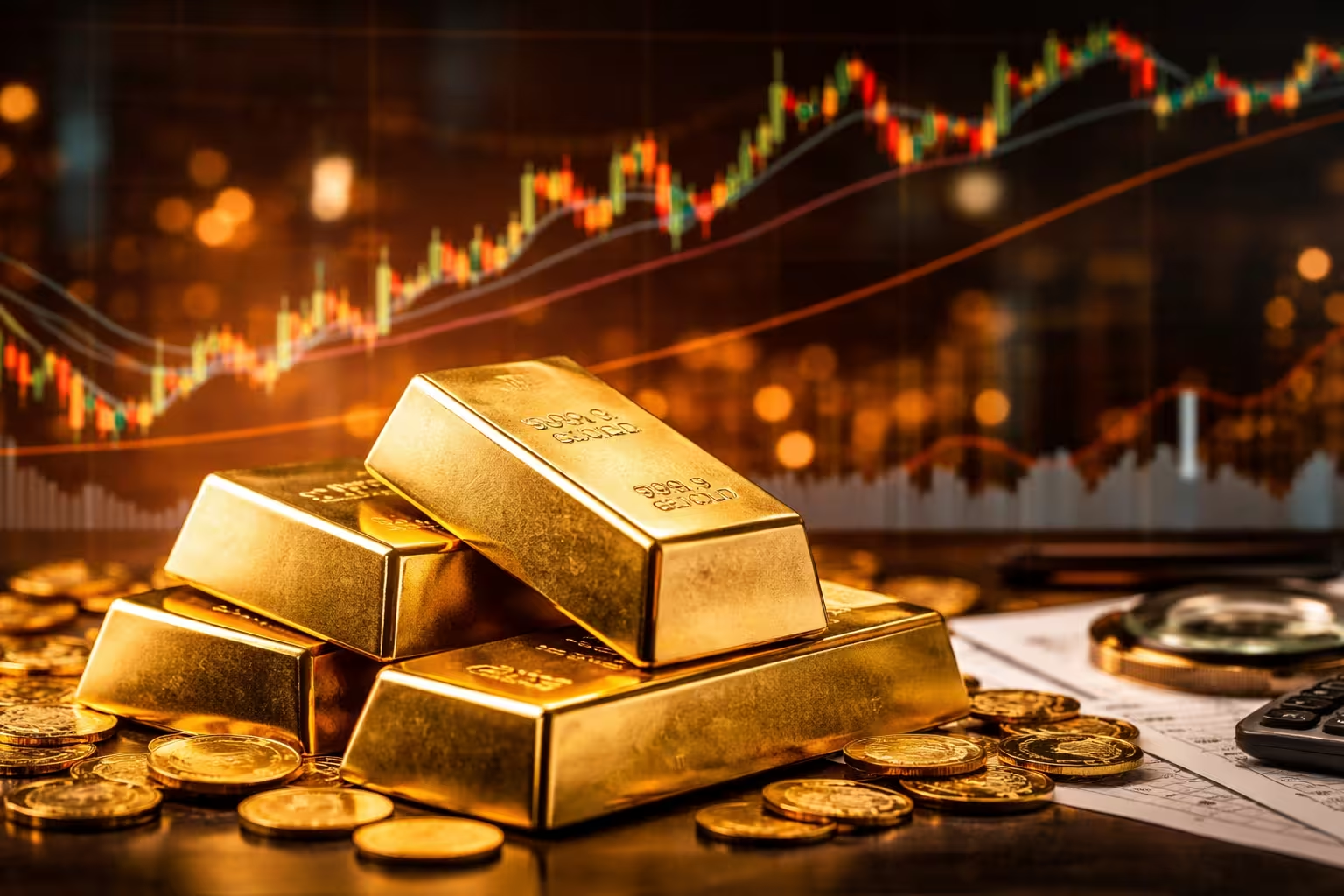
January 2026 wasn’t just a “good month” for gold. It was described as one of the strongest monthly performances in decades, with gold repeatedly setting new highs and briefly reaching record territory near $5,600/oz during the rally.
The key point is how fast the move occurred. Rapid price acceleration attracts momentum traders, short-term speculators, and leveraged positioning in futures and options markets. That can push a trend further than fundamentals alone would justify in the short run. Then, once the market becomes crowded on one side, even a single trigger can create a “trap door” effect—prices fall quickly as leveraged traders are forced to cut positions, and liquidity thins as everyone tries to exit at the same time.
You could see this dynamic clearly near the end of January: Reuters reported a day when gold touched a record high and then reversed sharply, falling more than 5% intraday from the peak after profit-taking set in.
That combination—record highs plus crowded trades—is the perfect recipe for the kind of volatility we’ve been seeing in early February.
The big volatility trigger: policy narrative shocks and the “Fed independence” trade
Gold responds powerfully to narratives about monetary policy and the credibility of central banks. In early 2026, part of the rally was linked to uncertainty around U.S. policy direction and “safe-haven” demand. When that narrative suddenly changes, prices can reprice violently.
One of the clearest examples in this cycle was the market reaction tied to U.S. Federal Reserve leadership expectations. Reporting cited a sharp drop in gold after news around nominating Kevin Warsh as the next Fed chair, which eased some investor fears of an overly politicized central bank—reducing one reason to hold gold as a hedge.
This is an important lesson for readers: gold doesn’t move only on “inflation” or “festival demand.” It can also move on confidence—confidence in institutions, policy stability, and whether the future looks predictable. When that confidence changes suddenly, the repricing can be abrupt.
Interest rates, the dollar, and why gold reacts so sharply to expectations
Gold is a non-yielding asset. It doesn’t pay interest the way a bond or a fixed deposit does. So when interest rates are expected to fall, gold often becomes relatively more attractive because the “opportunity cost” of holding it declines. When rates are expected to stay higher, gold can lose some appeal, especially for investors who are choosing between gold and interest-paying assets.
The key word here is expected. Markets trade on expectations before policy changes actually happen. That means a small shift in what traders believe the Fed might do—cut sooner, cut later, pause longer—can ripple through bond yields, the U.S. dollar, and then gold prices. Even without any official move on the day, gold can swing sharply if the market rethinks the future path of rates.
So when you see gold surge or drop in a single session, it may not be because “something happened to gold,” but because a chain reaction occurred: economic data or a political headline changed rate expectations, rate expectations moved yields and the dollar, and those changes moved gold.
The “metals fever” factor: speculation and leverage amplifying every move
A major reason this particular cycle looks unusually wild is the sheer intensity of speculative participation in metals markets. Reuters commentary has described a broader “metals fever,” highlighting unusually high volatility and repeated exchange interventions aimed at cooling overheated trading—especially in parts of China’s futures markets, where retail participation has surged and social-media-driven enthusiasm can accelerate trend behavior.
When large numbers of traders pile into the same trade—often using leverage—price moves become less smooth and more explosive. Rising prices invite more buying. That buying forces market-makers and other participants to hedge. Hedging can push prices further. Then, if the market turns, the same leverage can cause forced selling and margin calls, leading to sudden air pockets in liquidity.
This is why gold—traditionally seen as “slow and steady”—can suddenly behave like a hyperactive asset. The underlying metal hasn’t changed. The market structure around it has.
Central-bank buying is still a major pillar under gold
While speculative flows can create sharp swings, longer-term support often comes from structural demand. One of the most important structural signals today is central-bank buying—especially in emerging markets that want diversification away from the U.S. dollar.
On February 7, 2026, Reuters reported that China’s central bank extended its gold purchases for the 15th consecutive month, with holdings edging higher and the reported value of those reserves rising sharply as prices moved.
This matters because central-bank purchases are usually not “day-trade money.” They are strategic allocations. Even when gold corrects, steady official-sector buying can help stabilize sentiment by reminding markets that there is real demand beneath the speculative layer.
It also connects to a broader theme: many investors buy gold not only for returns, but as insurance against extreme outcomes—currency weakness, political stress, or unexpected shifts in the global financial system. Central banks often think the same way, just on a larger scale.
What India is seeing: high prices, hesitant buyers, and premiums cooling
When gold gets too volatile, physical buyers often step back—especially if they’re purchasing jewelry or planning weddings and want price stability. Reuters reported that Indian gold premiums fell sharply—more than halving from very high levels—because volatility and price swings discouraged buying, particularly after fears of an import duty hike did not materialize in the Union Budget.
The same report highlighted how extreme the domestic swings had become, with prices moving dramatically in rupees per 10 grams over a short period.
This “buyer pause” is normal in volatile phases. People don’t stop valuing gold—but they delay purchases, split buying into smaller parts, or wait for calmer conditions. That hesitation can temporarily reduce physical support in local markets, making domestic pricing feel even more jumpy.
China’s demand shift: more investment buying, less jewelry
Another clue about the nature of this cycle is the changing shape of demand. Reuters reported that China’s overall gold consumption fell again in 2025, but demand for bars and coins rose strongly and—crucially—bars and coins overtook jewelry purchases, signaling a more investment-driven approach among consumers.
In a world where consumers increasingly view gold as an investment instrument (not just ornamentation), demand can become more correlated with price momentum and macro narratives—meaning it can rise aggressively during rallies and fade quickly during sharp corrections. That’s another structural reason volatility can look higher than in earlier eras dominated by steadier jewelry demand.
Why volatility may stay high even after the record run cools off
A common assumption is that once gold stops making new highs, things will “return to normal.” But volatility often lingers after a major blow-off move because positions take time to unwind and confidence takes time to rebuild.
If you had a January surge driven partly by momentum and leveraged trades, February can become a tug-of-war between three groups: traders who are still bullish and trying to buy dips, traders who want to exit and take profits, and new entrants who wait for clarity before committing. That tug-of-war creates choppy markets.
Add the fact that gold is still tied to headline-sensitive themes—policy credibility, geopolitical tensions, central-bank buying, and global risk appetite—and you get an environment where a single headline can still produce outsized reactions.
What this means for readers: buying gold vs trading gold
For most households, gold is not a trading vehicle—it’s a store of value, a cultural asset, or a long-term hedge. The current market, however, is behaving in a way that can punish short-term, emotionally driven decisions.
If you are a jewelry buyer, volatility mostly affects timing and budgeting. The risk is overpaying during a spike and then feeling regret during a correction. The practical solution is often behavioral rather than technical: avoid chasing price jumps, consider splitting purchases, and focus on purity, making charges, and resale policies rather than just today’s headline rate.
If you are an investor, volatility changes your risk. Large daily swings mean you can be right about gold long term and still suffer short-term losses if you buy at the wrong moment or use leverage. This is why it’s crucial to match the product to the goal: physical gold for long-term holding, ETFs for liquidity and convenience, and futures/options only if you understand the risks and can handle rapid mark-to-market moves.
This article is informational, not financial advice—but the central idea is simple: in a volatile market, process matters more than prediction.
The next big question: what should you watch after Feb 7?
Gold’s next phase will likely depend on whether the market shifts back to “fundamentals” (rates, currency, inflation expectations, and steady official buying) or remains dominated by speculative flow and narrative shocks.
If central-bank buying continues at a steady pace, that can support longer-term sentiment.
If rate-cut expectations become clearer, gold may trade more smoothly—even if it doesn’t rally as explosively.
But if the “metals fever” dynamic continues—with heavy retail participation and leverage—sharp swings can remain a feature, not a bug, even for gold.
For readers, the takeaway is not that gold has “become risky” in the long-term sense. The takeaway is that the path to any long-term outcome may be far more turbulent than people are used to. After January’s record run, gold is still searching for a new balance—between real demand and speculative heat, between hedging and profit-taking, and between safety and speed.