Physical Address
304 North Cardinal St.
Dorchester Center, MA 02124
Physical Address
304 North Cardinal St.
Dorchester Center, MA 02124

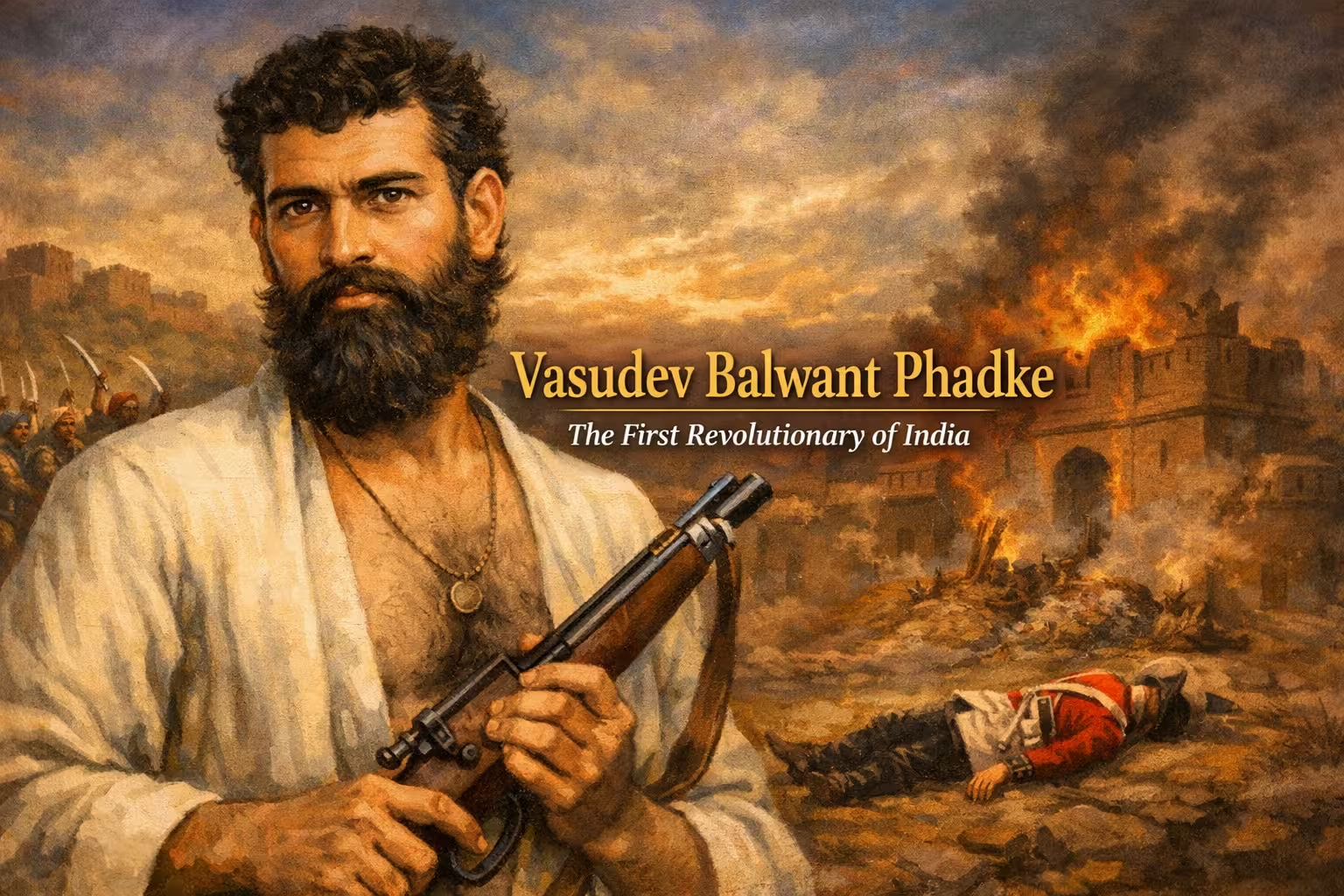
Vasudev Balwant Phadke (often spelled Phadke/Fadake) was an early Indian revolutionary who organised one of the first armed uprisings against British colonial rule in the late 19th century. Driven by the economic distress of peasants and inspired by regional heroes, he moved from a government job to militant activism, was captured and deported, and died in exile — yet his life inspired later generations of freedom fighters.
Vasudev Balwant Phadke was born on 4 November 1845 in the village of Shirdhon (Shiradhon) in present‑day coastal Maharashtra. He belonged to a Konkan family and received formal education at a time when few Indians did; he was among the early graduates of Bombay University. After studies he held government posts in Bombay (Mumbai) and later in Pune, where his work exposed him to the widening gap between colonial administration and the rural poor.
Phadke worked in several government offices — including roles connected to military finance and the commissariat — which gave him firsthand knowledge of how colonial systems functioned. During these years he came into contact with social reformers and local leaders who shaped his political thinking. Two of the most important influences were traditional regional pride in the legacy of Chhatrapati Shivaji and the grassroots teacher‑trainer Lahuji Vastad Salve, who had earlier encouraged and trained youth in self‑defense and community organization. These influences combined with the visible suffering of small farmers to push Phadke toward direct action.
By the 1870s Phadke concluded that petitioning or moderate protest would not ease the severe economic and social pressures on peasants — high taxes, moneylenders’ oppression, and exploitative local officials. He began building a small but committed force, recruiting from marginalized communities and those with local knowledge of the terrain. His plan was pragmatic: target government treasuries and rich collaborators to finance and sustain a wider popular uprising. Historians often call Phadke one of the first Indians to organise such a directed armed campaign against the Raj.
Phadke’s activities combined guerrilla raids with an attempt to build local support. He organised small bands that conducted raids on moneylenders and government depots, deliberately aiming to disrupt colonial revenue and to use the spoils to help the rural poor and fund further actions. His recruits included soldiers and tribal groups familiar with the Konkan and Sahyadri hills. While his force was never large enough to defeat the British militarily, his raids had an outsized symbolic effect: they challenged the perception of British invulnerability and introduced the idea of organised, armed resistance in western India.
Phadke’s growing activities drew the full attention of colonial authorities. He was captured in 1879 after years of clandestine activity and a series of raids. Following a trial, the British sentenced him to deportation rather than execution; he was sent to the penal settlement at Aden (today in Yemen). The harsh conditions of exile and separation from homeland took a fatal toll: he died on 17 February 1883 while still in exile. The facts of his arrest and deportation are recorded in contemporary documents and later official releases summarising his life.
Phadke is remembered not only for specific raids but for formalising the idea that ordinary Indians — including peasants and the rural poor — could be organised into active resistance against colonial economic structures. His insistence that “Swaraj” (self‑rule) was the cure to rural distress prefigured later, broader independence movements. While his methods were controversial (armed robbery and attacks on revenue), they radicalised political discourse in the region and inspired later revolutionaries who developed more organised political programmes.
वासुदेव बलवंत फडके — भारत के प्रथम क्रांतिकारी
After his death Phadke became a symbol for militant patriotism in Maharashtra and beyond. Statues, plaques, and memorials honour his birthplace and sites associated with his campaigns; historians and popular writers have repeatedly revisited his life to place him within the larger arc of India’s freedom struggle. Several modern scholarly treatments and popular histories — including archival reconstructions and dedicated biographies — trace how his life connected local anti‑colonial grievances to the idea of national liberation.
Today Phadke’s name appears in school histories, local commemorations, and civic monuments. Pune and other Maharashtrian cities remember him as a local hero whose radical approach predated better‑known organised political movements. Cultural memory also debates his methods: some celebrate his courage and sacrifice; others critique the morality or effectiveness of armed raids. Either way, his figure remains central to discussions about the origins of organised resistance to colonial rule.